
Wild Horses of Alberta Society
What does a writer do when she has a new book out? Write the next one, of course. And so here I am (behind the camera), out at the Wild Horses of Alberta Society rescue, near Sundre, Alberta, where I met with one of the founding members, Jack, and the resident horse whisperer, Ramona.
Jack felled trees on the property to make room for the operation in 2014. He and others lobbied the government to take notice of the wild horse herds in Southern Alberta.
Various academics have taken an interest in the herds over the years, as well, and conducted studies on them, including tracking their ranges, and testing their DNA. In the first case, it was found that horses have a wide range and move about foraging for food. This fact dispells the belief the wild horse populations overgraze ranchlands. Secondly, and most surprisingly to me, wild horses have distinct DNA. They are not related to the Spanish horse which was brought over to the Americas. Rather, the wildies may be linked to the oldest remains of a three-toed horse found beneath the ice sheets of the last ice age dated to 1,100 A.D. The theory is that horses were in North America before trappers arrived in the 1800s, and they most likely travelled across an ice or land bridge from Russia when the continents were connected.

Since many wild horses have unique and hardy genes, they are in demand as breeding stock. Many horses currently in residence are stallions. Of those, some are to go to other locales soon. One is slated for trail packing in Canada’s North; several others for an equine counselling centre in Europe.

Wild horses come to the rescue in many ways. Sometimes they are labeled as nuisance horses by land owners–and they are mainly males wanting to befriend domestic females. Other times they are found foals or mares in poor health, as the winters can be harsh with sparse vegetation making survival a challenge.
Wild mares may conceive any time of the year, and foals born during the winter months have a low survival rate in the wild. Often, an underfed mare will be unable to produce milk for her young; and foals face starvation along with predation from cougars, grizzly bears, coyotes, and wolves.

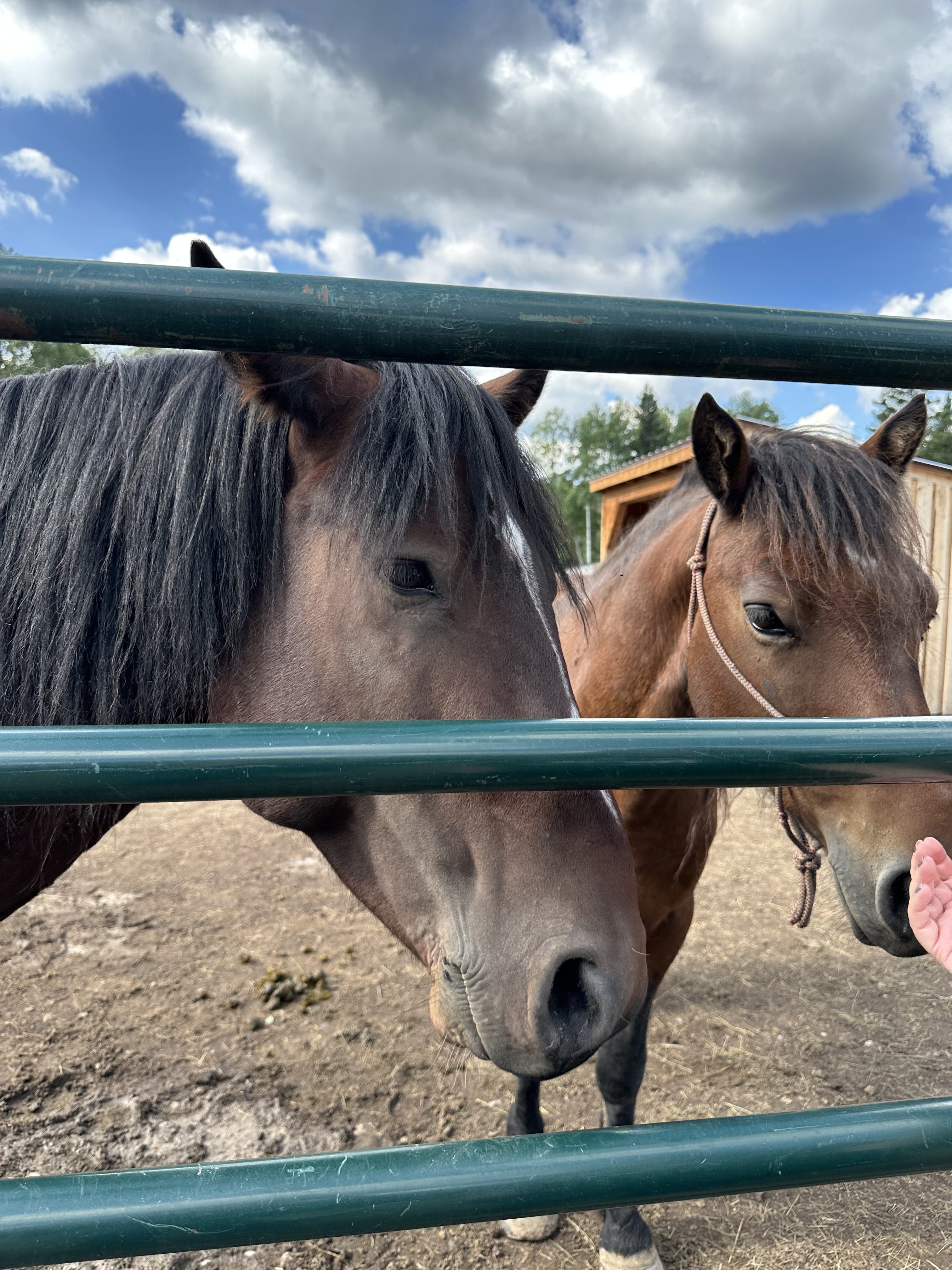
Yours truly, saying hello to the wild boys.

Jack, one of the founders of the society; and Douglas, the giant resident retriever.
Jack is an incredible source of history and current information regarding wild horses in Alberta and an upcoming program to help manage wild herds.
Moments before I took this video, these stallions were ‘playing’ by bucking, biting, and knocking each other to the ground. They play very rough compared to domestic horses.
Some horses take a long time to trust humans. Others, especially young horses, learn quickly. Along with Ramona, expert volunteer horse handlers work with the wildies, and they are tended by resident vetrinary students as part of their training. The horses must quickly learn to be comfortable in a shute where vets will perform medical procedures.

Ramona, the horse whisperer, spends a lot of time connecting with the horses. She teaches them to acept bridles and saddles eventually. She uses gentle methods and the horses come to her as they might if they were large dogs. A couple of the horses are so fond of her, that they’d climb onto her lap if it were possible.

In the office, Jack showed me photos of the horses who had been adopted over the years. Once the rescue takes on a horse, they may not turn them loose again. The practice of people ‘freeing’ horses became ilegal in 1960. Wild horses in the past were culled or sent to auction. Hopefully, with new herd management, culling will be a distant memory.


My time at the Sundre wild horse rescue facilty was informative and inspiring. I have several details to add to my next novel for families and young readers.
If you or someone you know is interested in sponsoring a bale of hay or even a horse’s stay at the facilty, please do not hesitate to get in touch with the dedicated team there. They offer tours to the public and consider invitations to speak to groups. Here is a link to their website: Wild Horses of Alberta Society.